Showing posts with label videogame. Show all posts

Saturday, October 26, 2013

Movie Review - Gallowwalkers (2007)

Simon Phoenix in Demolition Man. Nino Brown in New Jack City. "Flip" Purify in Jungle Fever. Shadow Henderson in Mo' Better Blues. John Cutter in Passenger 57. The dude that slapped Michael Jackson in the music video "Bad". The unnamed brother towards the end of Waiting to Exhale.  Blade.

These are the roles of the Wesley Snipes I know and love. Granted he's been through the ringer over his taxes and spent 3 years behind bars over them, he still turns in great performances. It was this last role that has given me pause: that of Aman, the main character from the direct-to-DVD movie Gallowwalkers. It's a horror-Western, so bear with me.
The reasonable facsimile of the American West setting is played by the Namib Desert, found in the southwestern African country of Namibia.  It is a very beautiful place, and is part of a country that has no extradition treaty with the United States (which is good so Mr. Snipes can make a movie without federal agents arresting him on site). That said, our story focuses not on taxes, but on a blood debt to be collected by butcher-turned-bounty hunter Aman (Snipes). He hunts the Gallowwalkers: a group of people he once killed in a rage of revenge for the rape of Sueno (Alyssa Pridham), the woman he loved. They have since come back and now wreak havoc on the world, which means one thing, true believers: Aman has to kill them. Again.

WESLEY SNIPES WINS
FATALITY
Aman is somewhat typical for a main character in a horror-Western: he is mysterious, wears a lot of dark colors in the hot ass sun, seems nigh invulnerable, and can do things normal men cannot. For instance, he shows proficiency in surgical procedures not seen since the first Mortal Kombat video game as he rips a Gallowwalker's skull from his body with the spine still attached with his bare hands.

Knowing the they're being hunted by a guy who can do that doesn't stop the other Gallowwalkers from running about and causing trouble. Enter the rest of the gang: Skullbucket (ex-wrestler Diamond Dallas Page), Kisscut (the wide-jawed Simona Brhlikova), and the others led by Kansa (Kevin Howarth).  They have distorted the ideas of law and justice to their own ends, and have marshal Gaza (Patrick Bergin) and his deputies under their thumb to provide access to fresh bodies. It's where we meet the kid Fabulos (Riley Smith) and the whore Angel (the very lovely Tanit Phoenix) about to be sacrificed when they are freed by Aman.  Only Fabulos escapes to partner with Aman in his quest for revenge, while Angel remains captured and will be a sacrifice to resurrect Kansa's dead son (also murdered by Aman).  Not content to suffer Kansa and his crew, Aman and Fabulos fight them to the last and save Angel.  There isn't much after that, as the director Andrew Goth goes for a Kurosawa-style western ending.

"Well, I suppose I have a little while before the
shoot is over and I have to go back to America
and face trial..."
This movie was not going anywhere aside to direct-to-DVD.  It had been in the can since 2007, but due to the tax thing it sat for 5 years or so.  Though the quality of Mr. Snipes' acting is not in question, but the level of technical expertise is inconsistent.  One minute, it's extremely stylized and the next it's on par with Bloodrayne II (hint: not a good movie). It's even interpreted that these Gallowwalkers are akin to skin-walkers, in a very literal sense: they are able to change their shape by killing and then wearing the skin of their victims.  That explains the constant bleeding even when they are not wounded. Visually it's amazing and strangely clear, but in terms of a story telling aspect it's one of a litany of problems in this non-linear tale of revenge and undead outlaws.

I truly wish this were a better movie and that it hadn't been delayed for 5 years, because then I wouldn't have to wait for Expendables 3 to come out to see Wesley Snipes in a mainstream movie.

Saturday, September 22, 2012

Movie Review: Resident Evil: Retribution (2012)


Any alien armada watching out broadcasts or monitoring our data streams of pirated movies can see that Earth has a sure defense against them.  Not the armies, navies, air or special forces of respective countries would be able to stand against the might of an alien invasion.  Rest assured the aliens know our first, last, and only true line of defense: MILLA JOVOVICH.

Yes, the actress/activist/fashion designer/singer/mother/former Ukranian supermodel Milla Jovovich has been in more movies where she is the last best hope for mankind against normal and supra-normal (including extraterrestrial and supernatural) threats (see The Fifth Element) and capable of handling acrobatic feats with ease (The Three Musketeers [2011]).  These skills are heavily in play in the movie series that placed her name on the minds of movie producers: the Resident Evil franchise.
In the review for the House of the Dead movie, I brought up Ms. Jovovich and her baby-daddy Paul W.S. Anderson--the man responsible for the movie translation about the CAPCOM survival horror videogame.  I bring her up again because this review for Resident Evil: Retribution before you is also a plea to Ms. Jovovich:  

PLEASE END THE RESIDENT EVIL FRANCHISE WITH THE NEXT INSTALLMENT, BECAUSE IT'S WORN OUT ITS WELCOME.
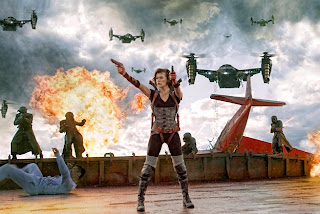
whileIstoptheinvadingarmy--POSE...
The Resident Evil franchise was fun when everybody was making video game movies, bringing our video game fantasies to life with actors we tolerate in the roles we've already cast in our heads (more often than not, with conflict).  With a movie-only character like Alice, we'd be interested to see what kinda hijinks she could get into and out of.  She's been through Raccoon City twice, the desert, Los Angeles, Alaska, and now every major world city.

The secondary heroes in this movie are veterans from the video game series: Barry Burton, Leon Kennedy and Ada Wong.  You find out most of the world which we've seen in previous installments has been a lie on a grand scale, rendering many of the movie's off-the-wall ideas quite sensible.  It's as if the world has turned upside down to accommodate the twists & turns of the Resident Evil franchise...almost as if this entire series was written out before the first or second film hit theaters.  If that's the case, kudos to the writers for such an amazing effort.  Unfortunately, there seems to be a few reused ideas in this movie from previous Milla Jovovich movies in the series that could be done away with in my opinion.

Time for a "naked break" from POSING...
1. Naked Milla Jovovich
I'm a dude; I like the ladies and what they are capable of doing.  It's a great thing to see an empowered woman do her thing.  It was a great thing in The Fifth Element and the first Resident Evil movie to see Ms. Jovovich in a state of vulnerability, represented by different levels of injury, nudity, and confusion/disorientation, because it allowed her to transform her earlier states into a form of RAAAAAAAGE.  She then pushes out of that cocoon as a "bullet with butterfly wings" and takes out what forms of oppression and evil that lay beyond the walls of her prison.  It's as if every scene like that is supposed to be a rape victim getting her shit together and striking out at their attacker.  These can be very powerful scenes to witness, like Uma Thurman's performance in Kill Bill: Vol. I, but when overused it dulls the meaning of the scene as it happens a SECOND time in the latest entry
Due to the number of times this happens in the Milla Jovovich catalog, I'm gonna take a wild guess and say that her days of being wrapped in funky clothes are behind her and she'd like to be able to act without any identifying markers: no clothes, no items, no fancy makeup, just her and her acting ability.  Nakedness comes in many forms, from full frontal to a nondescript set of clothes.  The next idea trashes most of that guess.

afterIslayabunchazombies--POSE...
2. Milla Jovovich in Clothes
While it can be assumed Ms. Jovovich has creative control over her wardrobe, she normally  chooses clothes that could be considered comfortable, functional, or feasible.  It can be assumed in the first movie in the series (back when we could only see Michelle Rodriguez as the tough Latina chick) that she was caught unawares when she was wearing the red dress outfit.  Over the course of the storylines she's gone from comfortable warrior to bondage queen.  This is not an overnight change: she didn't wear corsets until the fourth film and the latex costumes in the fourth and fifth movies seems to be the new norm. I guess they're trying to hide or incorporate the harnesses from the wire-fu shots, but c'mon.  Her wardrobe has some unintended consequences of influencing and highlighting Ms. Jovovich's acting style.

3. POSING
Ms. Jovovich's supermodel background has lent itself to the fine woman we see today.  The clothes she wore then probably were uncomfortable to wear, as they were designed for looks not comfort.  I keep mentioning comfort because if I were fighting zombies, I wouldn't wear a costume that could limit my range of movement.  As such, a fashion designer's runway collection and the PVC/platform boots costume from Retribution lead to many instances of posing--a stiff positioning of limbs for emotional evocation.  But hold the phone: she does this in her other, more comfortable outfit (the one where she uses a sawed-off shotgun filled with coins) and in her state of vulnerability/nudity.  In clothes, she stands legs apart and fires two guns while her waist is twisted slightly, making her look more powerful.  Without clothes (or just wearing some form of hospital shift that shows side- or under-boob), she is folded in a fetal position and/or low to the ground.  The implementation of these forms comes off as inorganic and they detract from the storytelling in this movie--what story there was to tell.

Enough about that, let's talk about the movie itself.
The movie tends to lean back into its video game roots, treating every challenge to be overcome as a level in a game.  This has the tendency to pop up in lazy screenwriting.  It did have its good moments, especially in subverting an age-old beef I have with the movie industry.  That makes up for a lot, but not much.

I would really like to hear more about Ms. Jovovich's musical career ("Gentlemen Who Fell" is still on my iTunes) or any other movie she's done.  If she has to make another movie about the Umbrella Corporation's crimes against humanity, then let it be the last Resident Evil movie in the series.

And the word the poster up top should replace the word "ultimate" with "pentultimate". It means "next to last", as in "you all need to end this movie series with the next film."  Please.

Sunday, November 6, 2011

Video Game Review - Shinobi III: Return of the Ninja Master (1993 - Sega Genesis)

Ahh, ninjas. Ninjas are a grand breed of battler and nowhere is this more evident than in the world of video games. Why? Because someone overestimated their fighting skills a very long time ago, during the feudal eras of medieval Japan. With that placed, let's review the fourth installment of the Shinobi series, Shinobi III: Revenge of the Ninja Master.
Shinobi 3 is the fourth part in the saga because its predecessor, Shadow Dancer: The Secret of Shinobi, is truly the third installment. It's a much inferior game compared against Shinobi 3, due largely to the fact that you can be killed by getting shot IN THE FOOT. Well, at least you got a dog. Then again, I don't think you got any ninja magic. Oh yeah, and you can get shot in the foot and DIE. Needless to say, Shinobi 3 improves on all of that.

After the end of Shadow Dancer, it's implied that our ninja hero killed the crime lord Zeed. Like most good villains, Zeed didn't stay dead and reincarnated himself as a cyborg crime lord called Neo Zeed. He's got a bunch of people under his command in is quest to rule the world. Almost everyone is powerless in the face of Neo Zeed. Emphasis on almost.

Enter Joe Musashi, the hero in the Shinobi storyline. He's got plenty of improvements over his predecessors while retaining all of their good moves. Chief among those moves is his Diving Kick; a move so useful that you can fight a boss using this move alone and still not touch the ground for an obscene amount of time. Joe's a ninja you can like and well worth the time you play. The music is all goodness and light, a masterful use of whatever instrument was used to make it. And then there's the stages.

The stages are awesome. Many are generic, some are challenging, and many are just plain fun. Some stages require you to use a different mode of transportation. Hence, the second stage makes use of your ninja horse and its Diving Stomp. Yes, I did say NINJA HORSE. The fourth or fifth stage requires you to ride a jet-powered ninja surfboard. A little overboard, but it's necessary: the other choice was a ninja dolphin. I always catch myself uttering one of Tone Loc's lines from Surf Ninjas when I reach that stage: "Black men don't surf!"
When all is said and done, it's the final stage that makes you work for that win. Well, the win after you fight a boss that absolutely, positively wants you dead.

When it comes to the game as a whole, I believe it has a lot going for it. A much respected video game franchise, this time is one of the gems in Sega's crown. I have to say that this game doesn't get its rating, but deserves it beyond a shadow of a doubt.

RATING: 8/10

Tuesday, October 25, 2011

Video Game Review - Crimson Tears (2004 - Sony Playstation2)

I am a big fan of the stuff that CAPCOM puts out. They have captured my attention since the days of Mega Man and Street Fighter 2010. I love their ideas and while I know that they only tolerate new ideas from the general poulace when making a new Mega Man villain, I'd still like to give them an idea or two. Here's my idea: make an action game in the vein of SEGA's Phantasy Star Online, but without the online part or the create-a-character part. It'd generally be a dungeon crawl, but without the crappiness of PK or online fees! It'd be brilliant!
Oh wait, they did that already? Crimson Tears? Never heard of it. Got to play it, and here's the review.

Set in futuristic cyberpunk Tokyo, three battle androids have escaped from a high-security facility because they stumbled on to some strange plot concocted by the evil corporation called ARMA. ARMA makes bio-weapons for the military, but something is amiss. The three rogue androids are out to put a stop to it, but they need to be stronger to do so. They set up camp in the city and traverse many levels to fight insane bosses to free not only themselves, but the entire city.
The three previously mentioned androids are Amber the ninja, Kadie the heavy blader and Tokio the gun master. Amber has dual melee weapon skills with swords and knives, but has poor hand-to-hand skills. Tokio can only use a few melee weapons, but he can use two guns at once a la Chow Yun-Fat. Despite Kadie's petite frame, she's the only one who can wield a buster sword. Their weapons, skills and combos can be upgraded to higher and higher levels and, in the case of weaponry, imbued with status effects or elemental effects. All of this is great and everything, but to give you just that would make the game far too easy to play. That's why the game designers decided to introduce the Heat Gauge.
The Heat Gauge measures how hot your android gets as it progresses through the game. When the gauge reaches maximum, the screen turns red and several things happen to your android. Your android can do max damage with every strike and runs twice as fast. While suffering from the status of being overheated(much different from the status effect "Overheat", which can be cured with "Overheat Cure" but not with "Coolant", which lowers your Heat Gauge and stops overheating), you take twice as much damage and your energy dwindles down to very little. If you're not careful, overheating can kill you. if you happen to survive a bout of overheating, your Heat Gauge will rest, but your HP meter will dwindle to 10% of max. It can be a bitch to keep your Heat Gauge down and your HP up and STILL have enough to deal with the enemies throughout the stages.

The enemies are where Crimson Tears really shines for me. I never thought that I would play a game where I'd fight not just ninjas and zombies, but zombie ninjas on top of that! Additionally, the enemies also level up along with you as the levels progress and eventually begin to use the same weapons you do. So, that scrubby soldier or robot you fought on stage 1 will be waiting for you on stage 4 and it'll have the strength to exact payback. And if you think that's tough, wait until you fight the Agent Smith-like "techno vampires" and the infamous "Mr. Black".
Bosses are strange and varied, and that's a good thing. From liquid ninjas to time-warping grim reapers, to the prerequisite evil characters with Biblical names [ex.: Abel and Eden] that are so common in Japanese sci-fi action, they all rock. That and they'll also mop the floor with you.
While quite entertaining when the enemy gets the drop on you, to the chore of getting every last item needed to create your ultimate weapon, Crimson Tears is not a game for the Madden and NBA Street set. Oddly, it CAN work for the Tekken set. Button-typing combos abound from this game, totally unrelated to the Konami game Crimson Sea or the Cliffhanger Comics title Crimson, but indirectly related to both Phantasy Star Online and the Ehrgeiz mini-game "The Forsaken Dungeon."


RATING: 8/10

Tuesday, October 4, 2011

Video Game Review - Streets of Rage (1991 - Sega Genesis)


And now, I recite the lyrics to the old TV cop show "Car 54, Where Are You?" as an opening to my review of the Genesis game, Streets of Rage:

There's a holdup in the Bronx,
Brooklyn's broken out in fights,
There's a traffic jam in Harlem
That's backed up to Jackson Heights.
There's a Scout troop short a child,
Khrushchev's due at Idlewyld--
CAR 54, WHERE AAAARE YOUUUUU?

Car 54 is providing backup to the only 3 cops who give a damn about their city, with the best firepower available to the local police force. More on them later. Let's focus on why the city is in the grip of terror...and the three brave souls determined to save it.
Mr. X, a crime lord of unparalleled aims, is taking over the city. He's flooding it with drugs, thugs and psychos. It's not safe in the daytime, and you'd be insane to leave your home at night for any reason. The police are doing something about it: taking bribes from Mr. X to look the other way. A few cops are fighting back, but many of them are fired or killed in the line of duty before they can go into action. Three cops decide to play by Mr. X's rules and take it to the streets!

The three people who fight a private war against Mr. X are:

  • Adam, a former boxer who is leading our trio
  • Axel, a brash young police recruit that treats every battle like a video game
  • Blaze, a female martial artist that doesn't take no for an answer

Each of these cops has pledged to fight Mr. X anywhere and everywhere he holds sway until his army of hoods and killers are off the streets. The three realize they ARE up against an army, so they have backup units. When summoned on the walkie talkie, the police cars pull up and fire either a bazooka or a gatling napalm in the general area, injuring many enemies. They have a limited amount of rounds, so our heroes call them only in times of dire need.
The army of Mr. X is legion, with some members more outstanding than others. With boomerangs, clawed gloves, super-strength, martial arts and the ability to breathe fire at their call, our heroes have their work cut out for them. Despite these forbidding opponents, the trio fight their way into Mr. X's penthouse suite and confront him. At one point, Mr. X tries to turn the cops against each other with the promise of riches and prestige. The act was all for naught, because the heroes want only one thing: to get JUSTICE for their city or die trying. Mr. X is more than happy to oblige them as his goons rush the heroes as Mr. X fires at them with his machine gun.

The battle was deadly and raged into the dawn. The sun rose just as Mr. X fell and surrendered. Justice was served and the streets of the city were free for its people. Adam, Axel and Blaze were commended and smiled great smiles as the sun beat down on their shoulders, relieved of the burden that were...the STREETS OF RAGE!

Our heroes (l-r, Blaze, Axel and Adam.) look out
over their city in "GOOD END."

Streets of Rage (titled Bare Knuckle in Japan) was basically a modernized version of a favorite game of mine, Golden Axe II. The characters in Streets compared to Golden Axe had similar traits, such as the case of the female character Blaze and her ancient counterpart Tyris-Flare. Both wore red, had excellent control of their movements and wore next to nothing. Axel and Axe-Battler had somewhat less in common; both wore blue, had the word "AXE" in their name and were musclebound lunkheads, yet Axel proved to be more useful than his earlier incarnation. Adam and Gilius Thunderhead, on the other hand, were not that similar. Both were wise, had powerful moves and a good reach, yet Adam was a 6-foot tall Negroid in a yellow tank top and that contrasted visually with Gilius' Dwarven stature and green clothing. The magic aspect of Golden Axe was replaced by the weapon-bearing police cars. But with all of these slight changes, one thing stayed the same between these two games: they were both extremely therapeutic.

The whole game was based on beating the ever-lovin' crap outta the bad guys. When you beat one up, there was another waiting, or more than one would challenge you. Once you got done with them, there was a stage boss to defeat. After 7 stages, the eighth and final stage forced you to fight every boss you already fought once again in order to reach the final boss. I always expect him to be hard as shit, and he never fails to disappoint. If I didn't beat it, I'd vow to fight the forces of evil much later--and win. When I did beat a game like this, I'd breathe a sigh of relief and revel in the credits and the feeling of a job well done.

This game's good, yet it could be better.  And that's why its sequel blows it out of the water.

RATING: 7/10

Saturday, September 24, 2011

Video Game Review - Street Fighter III: Third Strike (1999 - Sega Dreamcast)

This game holds a special merit in my life, due to the fact that they got a fighting game right on the money. Let's start with it's name of Street Fighter III: Third Strike.
Street Fighter III: Third Strike is nothing more than an attempt by CAPCOM to wring out another buck of its top man-whore, the wandering brawler Ryu. From the first Street Fighter to all of the modifications made on its sequel and passed off as brand new games, to the Street Fighter Alpha prequels that beat out the Star Wars prequel trilogy by 5 years, and through the psychotic Marvel branch-offs, Ryu has seen it all and has changed very little. Unfortunately, neither have his enemies. Same ol' Bison and Vega, Barlog and arch-nemesis Sagat. The stage music hasn't changed much and is even harped upon in other games. That all began to change with the original sequel to Street Fighter II, sequentially titled Street Fighter III.

The original Street Fighter III brought over the usual suspects of Ken and Ryu, but with better animations, new characters altogether, new stages and a new art style. There was a catch to all this cool stuff: you only had the choice of ONE Super-Art (the Super Attack from previous games) out of 3 to choose from. That made it hard to trip up your enemy, but they made the Super-Arts work at different levels on the Super Meter so that one Super-Art can be used 3 times with good damage, while a Super-Art that uses up the entire bar will cause massive amounts of damage. There are moves that I wanna talk about, but only within the context of Third Strike, because those same moves can be found in Street Fighter III and its sequel, Street Fighter III: Second Impact.

Third Strike, the third "sequel" to the third sequel in the Street Fighter> series (read that last sentence back and you'll understand how ludicrous that is to everyone else, but not to CAPCOM execs) brings back some characters from the Street Fighter III series, adding new ones and one revamped old-school character. The formula would seem to say, despite its features, that this is nothing but an old retread of the other Street Fighter III games. That's where Third Strike changes it up with a very significant change to the music.

CAPCOM went straight hip-hop.
It was a shock when I played the game and heard hip-hop beats blaring as I beat my opponents and  in the menus. It also allowed me to get deeper into the game than I ever wanted to. There are several instances where Street Fighter gets me and keeps me playing. Example of that are:
  • Ken getting 4 hits for his Flaming Dragon Punch (Street Fighter II: The New Warriors)
  • Ryu and Ken both fighting an insanely hard Bison--together (Street Fighter Alpha: Warrior's Dreams)
  • Fighting Shin Akuma at Ayers Rock, Australia (Street Fighter Alpha 2)
  • Ken's gets an Air Hadoken (X-Men vs. Street Fighter)
  • The VISUAL strike effects (Marvel vs. CAPCOM: Clash of Super Heroes)
  • The introduction of Captain Commando with the other 3 members of his squad as backup (Marvel vs. CAPCOM: Clash of Super Heroes)
  • The option of using 2 characters (Marvel vs. CAPCOM: Clash of Super Heroes)
  • The option of using 3 characters (Marvel vs. CAPCOM 2: The New Age of Heroes)
  • Three characters combining their Super Attacks together (Marvel vs. CAPCOM 2: The New Age of Heroes)
  • Star Gladiator's Hayato introduced as a 2D character (Marvel vs. CAPCOM 2: The New Age of Heroes)
  • The introduction of Sean and Elena, two dark-skinned characters of African ancestry that don't suck, are evil or boxers (Street Fighter III: New Generation)
  • Street Fighter III: Third Strike. The whole thing.
It took me long enough to say, but this game is awesome. The music is so great and makes you wanna go. The characters are good, especially new additions like Makoto (a karate mistress with exceptional power and spirit), Remy (a Goth version of Guile & Charlie), Hugo (a refugee of the Mad Gear gang from Final Fight) and Q (aka "the Unknown", neither man or machine). The most significant addition to the Street Fighter III character lineup was the re-introduction of the first female character in Street Fighter, Chun-Li Zhang.

She's dropped her Street Fighter Alpha tracksuit (so sad...T_T) and is back in her traditional costume. Her fighting style still has the high jumps and quick kicks, but shows a bit more grace in its animations. Chun-Li's Spinning Bird Kick has been changed so it doesn't look like she's doing a HEADspring and then spinning, but using a spinning momentum to get off the ground; so fluid it makes me happy to see it. She doesn't have a Kikosho, but her other supers are mean. Even her win poses are smooth, living things: Miss Zhang bows upon entering and the "V for victory" win pose is changed from static female-looking sprite pointing fingers upward to an excellent representation of Chun-Li having a silly moment.

On the antithesis of silly (i.e., serious), I present to you Ryu's Super-Art moves, starting with the Denji-Hadoken. An upgrade from the Shinkuu-Hadoken, Denji-Hadoken gives you the option to CHARGE the already powerful Shinkuu-Hadoken, much like Sakura's chargeable Hadoken in Street Fighter Alpha 2. The obvious drawback is that people can already prepare themselves for or act on the creation of a Shinkuu-Hadoken. The benefit is that it's UNBLOCKABLE. 'Nuff said for turtlers. That's not the end to his strength, for he also has the baddest move on top of that: the Shin-Shoryuken.
Normally, Ken is the better of the two when it comes to the Shoryuken, pulling off more than the single hit Ryu is capable of. Ryu has come back with a vast improvement over Ken's Shoryu-Reppa and Shin-Ryuken, called the Shin-Shoryuken. This Super-Art is so strong, it has a backup plan for when it misses its initial ground strike. On the ground, the Super-Art only gets three hits. It also knocks off an amazing 50% of health from the life-meter. The real gem is when the three strikes go off in sucession: Ryu hits with the first hand (a "closed body" camera shot), then the camera gets a close-up of the opponent's mid-section for a second hit (an "open body" camera shot) and ending with Ryu sending the opponent skyward with a rising uppercut. It may seem tedious to you, but to me it's ballet.
Lest we forget that if he misses the ground strike, Ryu has a chance to make a 15-hit aerial combo. It's impressive, but it doesn't pass Sagat's 21-hit Tiger Genocide from Street Fighter Alpha 2.

Street Fighter III: Third Strike is a milestone in gaming for me; it put almost everything into a fighting game AND not a lot of people hogged it up at the arcade. When something like that happens to a fighting game, that means there's something in it for me and will probably earn a high mark with me.

RATING: 8/10

Thursday, September 22, 2011

Video Game Review - Shining Force (1992 - Sega Genesis)

Shining Force was not the first RPG in the shining series that I played; that goes to the first RPG I enjoyed, called Shining Force II  Nonetheless, Shining Force gives us a little bit of history as to what its sequel will be talking about in certain points of the story. But we're here to review the second game in the "Shining" Series, Shining Force: the Legacy of Great Intention.

At first glance, the subtitle for Shining Force is powerful yet somewhat Engrish in its execution. That's not what you're here for. You're here to listen to a little girl named Meg read a story about a young man who sacrificed his life to save the world from the evil wizard Dark Sol (from the first game Shining in the Darkness) and his three-headed creation, Dark Dragon. She manages the save files for the game by the chapters read in the book, which is a detriment to those who must save on the fly. Because of the Chapter system, there is no going back to find missed items or playable characters. While this is a drawback, it doesn't diminish the fun I had playing it.

Playing this game after playing its sequel, *Shining Force II*, made the game a lot more fun than it should have been. I especially liked the reappearing young traveller Boken. Speaking of Boken, this game will always make sure that you try to help as many people as you can. The obvious reward is either items or a new party member, more often the latter. When you get your characters, just be prepared for some weird stuff.
When it comes to party members, *Shining Force* has some real doozies. You'll get characters like:
  • Domingo the magical jellyfish
  • winged birdman warriors like Balbaroy and Amon
  • Guntz the mech-suited armadillo
  • centaur knights(eliminating the need for both horse and rider by combining them)
  • Zylo the werewolf
and many others who will see you through to your mission of saving the world from evil.

The magic in the game sets a precedent as to how magic will be exhibited in the "Shining" Series games. Most magic spells have 4 levels to them, with more complex animations as the levels go higher. They're damn good magic spells to look at and are great for the system's power. The items in this game are pretty cool, with created weaponry being forged from Mithril only and cursed weapons being found in battle. Those kinds of weapons are usually found in the presence of bosses.
Bosses are a mixed bag: they can be sickeningly easy or hard enought to gain your respect after you've stomped a mudhole in them and walked it dry. I think that they'd all be the same with different sprites if it weren't for the terrain they chose to battle on. The terrain in which a boss (or any enemy for that matter) chooses is usually chosen to take advantage of the delay in traversing the terrain, thus limiting movement. In an open grassland, the terrain effect to movement would be 0%, while terrain effect in a swamp would be at the maximum of 30%--enough to knock out one or two blocks off your movement radius (an average of 4).

As I stated before, the game sets down ground rules as to how future installments in the "Shining" Series are run. I must say though, the ending may be pyrrhic but there's always a light at the end of the darkness... a shining light...

Saturday, August 27, 2011

Video Game Review - Terraria (2011 - PC/Windows)


I am a big fan of Toby "Tobuscus" Turner 's videos on YouTube.  He is very funny and makes videos one after another, seemingly without stopping.  At the time of this writing he is off at PAX 2011 doing live performances of his "Literal Trailers", but I went through his past video game clips and found some funny videos for PC like F.E.A.R. 3 and the game I am reviewing now, Terraria.
 Developed by Re-Logic, this game has been called "a 2D version of Minecraft".  I've read that in Game Informer Magazine and that's exactly the vibe I got when I looked at the game as Toby recorded his progress through the game.  I decided to play and I am hooked.  The sandbox design of the game and character customization are what I have been asking for for a very long time in almost every game I play.  I play Dungeons & Dragons Online: Stormreach for character customization, but I have yet to invest in the hardware that would allow me the sandbox feel of Minecraft.  What I have done instead is further my complex to reshape the world as I see fit.

I've build castles and honeycombed the earth, I've laid flat the sand dunes and driven the water deep underground.  I've even spanned jungle valleys and the craters of the corrupted zones.  This I do in search of materials and even greater tools to aid in my quest to...not sure what the main goal is in the game, but they provide several bosses to fight via Summoning Altars.  You don't level up, but you can find extra hearts and mana stars to lessen the damage.  Trust me; you'll need 'em. 
There are several zones to explore (jungle, corrupted, desert, ocean, etc.), in addition to various hazards to encounter along the way (monsters, nature, etc.)--all within a customizable options menu that determines the size of the world on which you play at the outset.  Currently, I'm playing in a Small-sized world; Toby's playing in a Medium-sized world.  I can only imagine the madness that a Large-size world would be...

There so much to the game that I can't fit all of it into this article, but I will add this tidbit: I've heard rumors about a floating island in the game made of gold ore, but I'll have to test that theory out for myself.  Not unlike a rare nugget, Terraria gets a great recommendation from me.

RATING: 9/10

Thursday, August 11, 2011

Video Game Review - Culdcept (2003 - Sony Playtation2)

There was a time, before Yu-Gi-Oh, when a collectible card game captured the socially disenfranchised youth of America with a magic wholly unrelated to the bond between a boy and his electric rat. Before that, another game made a point about how capitalism rocks the world through the mighty power of the thimble. For the record, I love the former and hate the latter of the two games described. The mish-mash of the two games, Culdcept, is an even-handed merger of the two.

From what's gleaned in the opening animation, the game employs grand artwork from some Japanese fantasy artists to tell the story of the goddess Culdra and her book Culdcept--translated as "the book of creation" in some language. There's some bullshit about how people on the world she lords over used the cards in the book (those people are called Cepters) to wage wars and, if they get the entire book, can become a GOD.

Cue the plot: There's a rogue Cepter called Geminigh going about destroying all the worlds previously created by other Cepters, prompting Culdra to send her magic cane (it talks!) to search for the Chosen One™ who will defeat the evil Geminigh. Naturally, that person is you.

With a cast of characters sure to make you laugh (by their trash talk and animated sprites alone), Culdcept ain't nothin' but the love child of Magic: the Gathering and Monopoly. Whether you win or lose, you get cards (spells, artifacts and creatures with perks like First Strike and a better version of Magic's Banding called Support). The lands on the Monopoly-like game board (with permutations) provide you with the magic needed to cast, but it needs to be occupied, much like the little green houses in Monopoly. When a chain of lands of the same element is obtained, the price of the lands goes up and the person who stops on your land must pay in magic. If they can't pay, they've got to sacrifice their lands or stocks until they can pay and be in the black while achieving a set number of gross or total magic.

Speaking of black, this game is a lot like Magic: The Gathering, but is missing the black mana of swamps and artifact creatures. Where Magic's white mana is now yellow and representative of wind, both the artifact and black creatures are mixed into a color category called Neutral. Hardly a compromise, considering that black cards are not neutral in any way.

Culdcept can get real cheap on you sometimes; you'll start out good and lose it all. Other times you'll have no creature cards--this game's 'Mulligan'--and have to walk the board discarding until you inevitably come out on top. This is an example of the game's many virtues. Culdcept allows you to have up to 10 different books of cards to battle with, giving you the opportunity to alter the 50 card deck you have or to switch between decks you've created. The game keeps stats on your battles and allows you to fight Cepters you've already beaten in Story Mode (one of 4 modes of play) for practice AND more cards to complete the entire collection. You can even trade cards via the Import/Export option with PS2 Memory cards. It's almost as though they thought of everything; sadly, they didn't. This game has one real problem: the game option 'Suspend". Suspend is the game's version of Battle Save or QuickSave, but not really. While those features in other games just stop the game to be resumed at a later time, Suspend does that and fucks you over by not giving you cards, gallery images or medals whether you win or lose. This can be a problem when you have interruptions that requre you to leave the house, barring your wanton waste of electricity.

Ultimately, this game is awesome and damn-near perfect, but only for those with nothing better to do during the summer. If you do choose to buy or rent it, prepare to surprise yourself by the speed you'll learn the game of Culdcept.

Friday, August 5, 2011

Video Game Review - Shining in the Darkness (1991 - Sega Genesis)

Role-playing games weren't big in my neighborhood or in my school growing up. If they were, no one was about to tell another dude that they played a game and leveled up their main guy to level XX and got all the items and keys to... by now, the person listening would've stopped listening and you'd be labeled a geek/herb/nerd/oreo/sellout/inarticulate insult here. Times have changed and the average person will only be mildly interested in the tales of your fighting dragons and the usual love story built-in to an RPG. Some things have not changed in the march of time and remain in place to this day, namely the dungeon crawl.

The game Shining in the Darkness was not the first to do the dungeon crawl; It's only one of many. It does bear the distinction of being the first RPG in Sega's "Shining" Series, created by the SONIC team. The game was set up in a first-person format and sets the history for the meat of the "Shining" Series, Shining Force and its sequels. The stories of the "Shining" Series are always told in hindsight by a visible narrator, who manages your save file by REMEMBERING where they left off in telling the tale. For Shining in the Darkness, an old man tells us tales of long ago. In memoriam, we live the life of our main character and his course to defeat the evil eminating from a nearby tower. We are also introduced to other characters: your partners Pyra (a whip-wielding wizardess) and Milo (a cudgeling clergyman), and the requisite royals with the notable but goofy court wizard Melvin, who ends up possessed by the evil in the tower to become the arch-nemesis of the light, Dark Sol.

The game is alright, but the lack of free (read: diagonal) movement hinders it a lot. The weapons you can make are built of standard stuff, such as Mithril, and cursed ore known as Dark Matter. The Dark Matter
weapons are strong but have their consequences to using them. Which is why I try NOT to use them; make do with what you got. The magic is sub-par for the abilities of the Sega Genesis in those years, but they
can be forgiven. With only 3 characters(counting yourself) to fight with on a regular basis and the occasional helper, this game only serves as a history lesson as to who Dark Sol is and the history of the world of the
"Shining" Series.

Thursday, July 28, 2011

Video Game Review - Wild ARMs (1997 - Sony Playstation)

I consider myself open minded about video games and movies. When I look back on some of the games I've played (Final Fantasy Tactics, SaGa Frontier) and the movies that I've seen (Falling Down, Manos: the Hands of Fate), Im proud to say that I've done a great service to the world. That service being the idea of looking at a bad video game or movie and rating it properly. Sometimes I find a gem in the sewage of the bad movies.  Other times I'll find the experience of a game to be far better than the game itself. This is one of those games.

Wild ARMs is an RPG that is considered innovative. It may be considered innovative because of the ability to switch characters and move them independently of each other, but I doubt that would over shadow the main reason why this game is a note in RPG history: it's a western.
Not the first RPG with a western theme (Oregon Trail, anyone?), Wild ARMs takes a lead from the TV show "Wild Wild West" but in the way that only an anime-influenced game could. This leads us to our three heroes.
  • Rudy Roughnight - A young blue-haired boy with the amazing ability to use ARMs (read: guns). There's some mystical bullshit about who can and can't use ARMs (plot point). This kid'll be your main guy for a while & he's generally considered the hero.
  • Jack - A treasure hunter whose intro owes a lot to Raiders of the Lost Ark and Benny Hill chase scenes. He's also a master swordsman, whose skill is a "Quick Draw" (??). Very suave and very dependable in a fight.
  • Cecilia - She's some magic chick. She can heal and stuff, just like every "staff chick". She's also the only one who can use Summon skill. She's a prototype version of Final Fantasy X's Yuna, but not as well known.
Wild ARMs' mild popularity owes a lot to its predecessor, Final Fantasy VII. There are many instances where a story element will draw a parallel to FF7. Summon stones are one; fighting the final boss in a weird dimension is another. The game's main protagonist has a gay first name and a manly last name, per the Squaresoft fashion. You'll even have to fight large machines of elemental origin, akin to the Weapons in FF7. The game does have original points, however.
First is the fact that the Summons can be enhanced. This was before the leveling up of Guardian Forces in Final Fantasy VIII was made necessary (much less, made). The enhancement of the Summon skill used on an equipped Summon stone could not only do double damage but also provide a better summon animation.  Second is the personal vehicle of travel. It's much better than the Highwind, but its drawback is the need to find an engine component in order to completely explore the known world. Strangely enough, Cowboy Bebop's Swordfish airplane may be borrowing from the design of the transport.
Third on the list is an action that shocked me to the core. I never thought that an RPG hero would go that far to save the world, but I was wrong. There was a reason why it happened, and I don't think any RPG can top that. To tell you what it is would destroy the whole shock value of the act, and I believe that everyone should experience it.
Music in this game is superb, and has 1960s influences. Of particular note, the Map Screen music is a reprise of "The Ecstacy of Gold" from Enrico Morricone's soundtrack to The Good, the Bad & the Ugly. While the music is great, the graphics needed work. These two factors canceled each other out, leaving me with the experience to decide the rating.
 
I'll have to give Wild ARMs a 6, because it was only alright then. The "shocking action" is the kicker that put it up to 6 in the first place.  The game has since been remade into Wild ARMs: Alter Code F, with better graphics, for the PlayStation 2.  I have no idea what Alter Code F means, as I haven't played it.

RATING: 6/10

Tuesday, July 12, 2011

Video Game Review - PaRappa the Rapper (1997 - Sony Playstation)

 *INTRODUCTION*

Once upon a time, there was a thing called hip-hop. Hip-hop was good, because it did not infringe upon the world at large with sappy pop hooks or massive metal guitar riffs. It was also good due to the fact that it appealed to the ethnic inner-city massives who took it as their own thing, not to be mistaken for pop music. And then the world began to incorrectly link hip-hop with not only people of color, but inner city crime as well. With a triad of trouble afoot, the Man sought a way to squash hip-hop. Through the interference of record companies, hip-hop was spliced into the parent and its offspring Rap. 
 
Rap didn't heed the word of the elder Hip-hop and began to talk about that which needed no conscious mouthpiece: the commission of crime. Thus began the rift between what was Hip-hop and what was Rap.

Things went from bad (meaning bad, not bad meaning good) to worse in the coming years, with the 1992 Los Angeles Riots highlighting the need for a stronger, pointed message than the words of the forefathers. Enter "Gangsta Rap", a form of Rap that's like a cigarette without the filter. It was misogynistic, homophobic, materialistic and ill-planned as a way to discourage violence and crime through overexposure. All the hatred spit out in rhyming prose to a sweet baseline from the days of our grandfathers was aimed in the general direction of their perceived enemy of White America. The sad thing is that Gangsta Rap behaved like the gangsta's attack of choice, the drive-by shooting: it had a habit of hitting unintended targets. The unintended targets: the children of White America.

It's unknown whether the children of White America were being used as pawns against their parents or if it was a mistake in getting through to them instead of the parents. While some members of the Rap community would take steps to have their life imitate their art, White America was listening and was more than happy to make it a part of their daily newscast. And suddenly, Rap became cool for everyone... but for all the wrong reasons. The gates to what makes Rap tick were opened and now there's other offensive strings of Rap (see: Nerdcore, Rap-Rock.) Who could have known that Rap would grow into the abomination we hear and praise so often? Only Hip-hop did, and it tried to come back and claim its moral grounds. Unfortunately Rap had a stranglehold on beats and rhymes in their origin country of the United states, forcing Hip-hop to find greener pastures in foreign lands.

Hip-hop has flourished in other countries like Germany, France, the United Kingdom and has done especially well in places like Canada and even the Arab country of Yemen (where the only acceptable music is drumbeats and the word is king). Of these countries, Japan stands out because it has the wackiness to inject humor into a socially conscious medium without degrading it. Rap and Hip-hop are fighting over control of the Land of the Rising Sun, the details of which can be read in the
game context of the PlayStation game, PaRappa the Rapper.

-----------------------------------------------

In the game PaRappa the Rapper, you play the titular character PaRappa. He's a hip-hop dog who's in love with the local beauty named Sunny. She's a sunflower. In his effort to raise a band and impress the girl, he becomes involved in scenarios to reach his goal. While many of the activities in the scenarios are physically oriented, PaRappa's forte' is rappin' to the beat. Thus, the only way to complete the scenarios presented to the gamer is to rap to the preset beat markers in a timely manner. Failure to do so results in a poor rating, by which a satisfactory rating is rewquired to pass all scenarios. An added bonus to the scenarios is the freestyle option when your rappin' rating goes beyond "U Rappin' GREAT!" So long as you rap to the beat, you can rap what you feel for bonus points.

PaRappa the Rapper is an animated video game tale created by Rodney Alan Greenblatt, an American expatriate living in Japan. He is responsible for the artwork in PaRappa the Rapper, as well as the PaRappa spin-off game, Un-Jammer Lammy (a story about a ewe who dreams of rock-stardom). His ideas of merging music and story into an interactive experience has been duplicated in the more recent incarnation of the PS2 titles Gitaroo Man and Mad Maestro.

The feel of PaRappa the Rapper is a silly one, due to PaRappa's adventures involving an onion-headed Kung-Fu master (called Master Chop Chop), a chicken chef with her own TV show, a moose that works at the DMV and a materialistic Rastafarian frog (my personal favorite). All of these characters have their own flavor to them, making this game a distinctive if not singular experience. The extensive advertising behind PaRappa the Rapper was grand and it was featured on a PlayStation demo disc, as well as in several commercials featuring the characters spouting lines from scenarios: The Rastafarian frog says "In the rain or in the snow/Got the got the funky flow" and PaRappa's exclaim of faith in his rappin' abilities is "I Gotta Believe!" Despite the want from both quotes to be THE line from PaRappa the Rapper remembered, only Master Chop Chop's line of "Kick Punch/It's all in the mind" stands the test of fleeting interest.

The limited graphics and processing power of the PlayStation are the only limits to the original PaRappa the Rapper reaching the maximum score allowable, so this game gets a rating of 9.

RATING: 9/10

Friday, July 8, 2011

Video Game Review - Gunstar Heroes (1993 - Sega Genesis)

I've had many people say that I have the speech mannerisms of a psychologist. With that in mind, I'm going to do some word association with myself. Here we go.

Day. ...night.
Ham. ...burger.
Surf. ...er dude.
Car. ...wheel
Gun. ...star Heroes.

When all the associations were made, one conclusion was clear: Gunstar Heroes is the greatest game out there for the Sega Genesis.

On the planet Gunstar 9, home of the family Gunstar, trouble was afoot. Some crazy-ass space monster was menacing the planet! White Gunstar, patriarch of the Gunstar clan, sent out fighters to deal with the incoming threat. The twin brothers Red and Blue Gunstar headed to the disturbance on foot, while the older Green traveled to the site in his transforming platform, Seven Force. The mission went wrong somehow and not only did Green become evil, but several other members of the Gunstar family have gone rogue under the command of Commander Crimson (he looks like M. Bison from Street Fighter) Crimson's using the robot armies of Gunstar 9 to wipe the Gunstar clan off the planet and take the space monster's power for himself! The fuck is a nigga supposed to do?

One thing left TO do: buck shots.

Gunstar Heroes is what I like to call "Contra on crack." The game moves at a fast pace, with tons of baddies to shoot and bosses that don't hold back. They fight you with style and force. No cheating-ass tactics, these guys. The music's great and and you can combine two separate special weapons to create a better special weapon. What makes the game even better is the fact that when you choose a specific character (either Gunstar Red or Gunstar Blue) that each player has a deficiency in their game play. One guy has better hand-to-hand techniques, but he can only shoot while standing still and the other can shoot on the run but only do minimal hand-to-hand damage. These little design flaws are what make a 2-player game better than a 1-player deal: you HAVE to work together to win. To bring it to the present, such a tactic is employed in the GameCube RPG Final Fantasy Crystal Chronicles. But who wants to carry around a jug of water when you can save the galaxy!

There are many people who have not played Gunstar Heroes, and it shows when you mention the game. Their eyes are dull when the words finish and still they choose to be lost in supers, specials and combos. For the legion of people whose eyes flare with a gem-like flame when mention of the Gunstar family makes it into a conversation, you can agree with me when I give Gunstar Heroes for the Sega Genesis very high marks.

RATING: 10/10

Wednesday, June 29, 2011

Video Game Review - Phantasy Star Online (2000 - Sega Dreamcast)

When I first heard about this game, I said, "Hmm. Phantasy Star. I've been meaning to play that game." I meant the original Sega Genesis games of Phantasy Star parts one through four. I eventually got to play Phantasy Star II, but the game in question was featured on the game system I hated: the Sega Dreamcast.
The Sega Dreamcast was initially an abomination in my eyes due to its presentation of the game Soul Calibur. The Dreamcast was so powerful that its rendering of games was better than the arcade version of the game. At this point, I always believed that the arcade port of a game should surpass any console version of the game. This notion was assaulted by the Dreamcast and I began to shun it in earnest. I didn't last long, because of games like Power Stone (and its sequel), Street Fighter III: Second Impact, Street Fighter III: Third Strike, this game and the rampant NES, SNES and Genesis ROM CDs I had burned by friends. The bloody thing was a treasure of time-killing. I soon learned to love Big Brother--I mean, the Dreamcast.

I started watching the game being played both on-line and off and I came to a revelation: this is how the future of gaming SHOULD be! You go online and quest while fighting monsters alongside friends! What could possibly go wrong? The only thing that could go wrong: human error.

Phantasy Star Online (we'll call it PSO for now) became a haven for a truly idiotic market scheme: players could sell the Meseta (fake money in PSO) they earned from playing PSO and then go online and post them up for sale on eBay, for a certain rate. Other PSO players would respond and pay REAL money for FAKE money and meet up in the PSO world later and exchange Meseta. The Meseta (read: FAKE MONEY) would then be used to purchase stronger weapons and armor that was not previously affordable, thus allowing the user to strike harder, absorb more damage and level up faster than normal. This looked like it was gonna work, no matter how silly it seemed--and then Sega started charging for online accounts, which were previously free. More often than not, people were on PSO because it was (a) cool and (b) free. Thus began the mass exodus of free account users to greener pastures.
There are more Massive Multiplayer Online Role-Playing Games out there now (Dungeons & Dragons Online, Conan, World of Warcraft, RIFT, and Final Fantasy XIV) each with its own flaws, problems and users whose lack of self-control get the game developers unwarranted press. None of these games captured my imagination more than the visual masterpiece called PSO--Phantasy Star Online.

The whole look, feel and urgency put into Phantasy Star Online came through so well, not to mention its initial character creation interface. This is where I really began to like the game. You could choose from 3 classes, each with 3 character templates, for a total of 9 possible characters with specific base stats.  Then you had a palette of colors to apply to clothing styles, faces, hairdos, skin tones (if applicable). You could even control the body proportions! These functions were a bit cumbersome to master, so there was a randomizer that spit out random variables and made a character quickly. When you finally named your character, you were assigned a color badge based on the structure of your name. And off you go to the Hunters' Guild to join in the story of PSO.
The story goes that the home planets of an indigenous race have died and they are searching for a suitable planet. Probes sent out came back with the loction of a suitable planet the leaders of these transient people named Ragol. The transport ship Pioneer 1 went to check it out and said it was all good. Then Pioneer 2 came along, a massive generation-type ship that carried the bulk of all the dying worlds on it. Pioneer 2 arrived at Ragol and tried to contact the Pioneer 1 colony on the surface, but just as contact was established the link was broken by a massive explosion visible from orbit. The president of Pioneer 2 sent some adventurers led by his daughter, Red Ring Rico, to investigate. They never came back, so now he wants you to investigte what became of his daughter and the crew of Pioneer 1.

The game is all anime and super-simple sci-fi than all get-out. The menus you use to organize and make use of are straight and to the point; the quick-menu avaliable by a few button presses is even more so. The world you inhabit in downtime is small but richly detailed. Everything's glowing and shining and floating and flying and whooshing by. On the surface of Ragol, it's very beautiful and your surroundings are the perfect distraction for the mutated denizens it holds in its depths who want to kill you. The bosses are massive and more than hard enough. You'll need to watch how you fight them and make use of your little sidekick buddy, the MAG.

In watching this game, the visuals and the music all had me in a mental tizzy. Why? Because the visuals are how I imagined the future would look when I was a little boy. Hell, I still think that the future can look like that, but I feel that the amount of human error we allow will limit the level of technological advances we want to have. Basically, it's stupid and greedy people that prevent us from colonizing the Moon and having androids, airships and flying cars back on Earth. Until we can get past that, the world will have to settle for the imagined future world of Phantasy Star Online.


RATING: 9/10

Monday, June 27, 2011

Video Game Review - Suikoden IV (2005 - Sony PlayStation2)

I had been really distracted with the creation of my second animated feature and I had completely lost track of when Suikoden IV was coming out. It took a reminder from my college friends to bring back into the fold of the 108 Stars of Destiny.  When I heard it was finally out, I went right out and bought it. Needless to say, it's become one of my favorite games to relax with.
Upon watching the intro movie, I thought that the game would suck. I also thought that the sailing would be peripheral to the main gameplay. How wrong was I about this prequel to the first Suikoden? Plenty wrong, on both counts.

Our story follows the exploits of a young knight-in-training and his fellow classmates. The most notable of his classmates is the young man called Snowe. Snowe, while not truly your rival, is very jealous of the praise heaped upon you. He's instrumental in your banishment from your home of Razril upon your receiving the rune of this game -- the Rune of Punishment -- from your dying commander. Blamed for your commander's death, you are set adrift at sea. It looks as if you're done for, until you realize the beauty of true friends that is the driving force behind the 108 Stars of Destiny. And that's where the most awesome island-hopping adventure begins.

As previously mentioned in the Suikoden III  review, I hoped that Konami would take a page from the Pirates of the Caribbean game and improve upon it. I also hoped that they would go back to the original type of World Map, instead of the "point A to point B" interface. The game designers have done one better and did it their own way. Not only did they combine the free-roaming World Map of older games and the "point of interest" format from Suikoden III, they have cut out the micromanagement of the sailing system in Pirates of the Caribbean. While some have said that sailing is a pain in the ass, it's one of the most visually relaxing and constructive things I have had the experience to do. Why? Because the game has done something that I never thought they would do: the castle from all previous Suikoden games is now a large sailing vessel--almost like a cruise ship.

Above: The current wielder of the Rune of
Punishment, a Rune that has an unfortunate
side-effect of slowly killing its host.

Speaking about the ship, the ship allows you to do another thing that has me torn. The game designers have eschewed the traditional six-man party and brought it down to a four-man team. While this would be a pain to me, I have realized that the four-man team holds true only on land. When on the deck of the castle-ship you have access to all 108 characters, so the ship allows you to create two auxiliary parties of four to call topside. This increases your World Map party to TWELVE, double the previous sizes in Suikoden and three times as large as the Basic Party. This creates a way to level up scrubby characters you don't want in your Basic Party (aka "the landing party") and allows you to work out the one problem I have with this game: earning team-up attacks.
Team-ups happened whenever people with common traits got together in the same six-man party. If two people with uncommon traits had a team-up attack, the results were usually hilarious (see Nina and Flik's "Groupie Attack" from Suikoden II). Now, the people marked for a team-up attack must stay in the same party for a number of battles until the team-up attack is discovered. This wastes a lot of time where deciding who should go in what team is concerned.

There are a lot of great things about Suikoden IV that easily overshadow the having to earn your team-up attacks. The minigames are totally awesome, and fun to play. They still have Chichinronin for the old-school gamblers and some new games to burn hard-earned cash on. You can make your own accessories and armor on your ship, and look around at everything and everyone with a first-person camera option. Most importantly, some of the characters you meet in your quest to gather the 108 Stars are references from the previous games. It's great to learn that rune mistress Jeane was always a hottie, Viki was always scatterbrained and the name "Scholtenheim Reinbach" is not just a name that Viktor made up in the first Suikoden to get past the guards.

With all that's available to you in the course of your career of "privateering" (licensed piracy in the name of the kingdom of Obel), this game is a grand addition to the Suikoden storyline. I anticipate Suikoden V, yet I have no idea where it could be headed. Perhaps the story will take a cue from the Final Fantasy series and sail into the far-flung future, bringing extraterrestrials and cyborgs from across galaxies into the fold of the 108 Stars of Destiny.

RATING: 9/10

Friday, June 24, 2011

Movie Review - In the Name of the King: A Dungeon Siege Tale (2007)

I'm writing a review about a director I used to hate--yes, USED TO--is because I have decided to make a compilation of reviews, to show Herr Direktor's progress from his big break (House of the Dead) up to his latest film. The latest film is the one I review now with the mouthful of a title In the Name of the King: A Dungeon Siege Tale.

The movie is one of several video game properties Herr Direktor picked up around 2004 (as mentioned in the Bloodrayne review) to make a quick buck off a pre-existing video game storyline. Dungeon Siege is a a game where you quest to rid the world of great evil from humble beginnings as a farmer to a mighty warrior or spellcaster. There are other character along the way to help and they join your quest, making it a lot easier to take it to evil's face. It's a cool game that has spawned 2 sequels and more expansion packs, and now a movie.

Our story follows the mysterious man known only as Farmer (Jason Statham) and his pretty wife Solana (Claire Forlani) and his nameless son (nameless for a reason). He lives a boring life and tries to keep to himself, even with constant pestering from his neighbor and friend Norrick (Ron Perlman) to join the army and fight back the subhuman menace known as the Krugs. Farmer politely declines the offer yet easily dispatches any Krug scouts on his land. It makes him wonder how he'll protect his family (duh, use your ass-kicking skillz) and who commands them. Who or what would do such evil things? WHO, I ASK YOU? WHO?!
The answer lies in the hands of a rival royal court magician Gallian (Ray Liotta), who schemes to take over the kingdom of Ehb from King Konreid (Burt Reynolds) by force and fell magic. He's so sure he'll win that he has time to seduce Muriella (Leelee Sobieski) ina bid to overextend her father, the great royal magister Merick (John Rhys-Davies). She holds the key to great magical power and if he can sap enough to become more powerful than Merick, Gallian would rule the kingdom...and he wouldn't stop there. Thankfully, he made the mistake of killing Farmer's son (toldja there's a reason) and in-laws, as well as kidnapping both Norrick and Solana. If he didn't we'd have no movie and I wouldn't be able to introduce these other characters in short order:

  • the elf-like Elora (Kristanna Loken), who meets Farmer in the forest with her "dryad warriors",
  • the King's nephew Duke Fallon (Matthew Lillard), a sniveling opportunist who conspires with Gallian in exchange for a stake in the new regime,
  • Commander Tarish (Brian White), AKA "the Blackman", captain of the King's personal guard, highly competent swordsman and nice guy all-around.
What happens in this movie defies logic found in script-writing 101 classes at your local community college. People are harassed when they could just as well be back in their cells, warning signs are ignored, and Farmer is revealed to be King Konreid's long-lost son previously mentioned once or twice. The writer has even decided to throw in a Star Wars reference in poor taste. The movie culminates in a split battle between the Krugs and Konreid's forces, and the final showdown between Farmer and Gallian. Both fights rock face, but the ending was kinda left unfinished. With the final CG camera sweep over the mountains, one can only assume the entire script must have been a poor re-imagining to one of the better computer games out there.

Yeah. I said it.

Thursday, June 23, 2011

Video Game Review - Suikoden III (2002 - Sony PlayStation2)

Suikoden III is a game that is a worthy success or to its predecessors, in that it keeps almost all of the wonder and characters of the original stories. The game raises the ante on game play by allowing you to play as one of three heroes (via the "Trinity System") that will inherit the name you chose at the beginning of the game. While the character you choose will not be named that, the character you named will be that of the legendary man known as the Flame Champion.

Legend has it that the Flame Champion is a young man who fights for freedom and justice while bearing the True Fire Rune.(The Flame Champion might be a composite of both heroes from Suikoden and Suikoden II.) The problem with the authorized legend is that it depicts the Flame Champion as a warlord bent on destroying civilization and leaving a flaming ruin in his wake. So when rumors of the Flame Champion start to surface among the many tribes of Grassland, the government reacts quickly to quell any uprisings. This introduces us to 2 of our heroes.

The first is Captain Sarah of the Knights of Zexen, also known as the Silver Maiden. She's a swordswoman loved by her people and revered as a hero. The second hero is Hugo, son of Lucia, leader of the Karaya Clan. He is always accompanied by his gryphon mount, Fubar. Yes, Fubar (military acronym: fucked up beyond all repair). Our third hero is on the other side of the map when most of their story goes down, but he eventually becomes a big part of it. The man in question is Geddoe, captain of the Holy Harmonia Southern Frontier Defense Corps, 12th Division. His skills and choice of magic rune echo that of a prominent character from the series.
The search is on between all these parties for things that matter to their separate missions, yet the searches push them closer to each other in an effort to stop a clandestine plot to destroy the world. The villain in question is someone from previous Suikoden games, and the last person you'd expect. That's all I can say about the story itself, but I can say more about the game.

A game that can stand on its own with bonuses for those who have stayed on for this latest installment, Suikoden III is a great game. The use of 3D characters and surroundings rendered in acceptable proportions was a very good idea, as well as the inclusion of the feature to upload old Suikoden II data.  Many other factors made this game extremely fun to play, yet there were some flaws that I had issues with. These issues were enough to bring the game's rating down one point on the rating scale, because they violate a set of laws with amendments I have set aside for RPGs. These laws I have in my head are necessary to make an RPG flow as smoothly as possible. I understand that many RPGs try to be different to draw an audience, but some gimmicks shouldn't be done. On with my beef on Suikoden III.


Above: The former wielder of the True Fire Rune,
The Flame Champion. Long since dead, he leaves his
legacy behind for the next Flame Champion to lead
the people against tyranny.
First, the Trinity System.
This feature violates a rule that stipulates ONE main character per game, and all others act as NPC's in the event they are not chosen and cannot be used again until all the chapters of the story are complete. It does look like the Trinity System follows this rule with the goal of being chosen as the next Flame Champion, but look again. The user can switch between characters at the end of each chapter, which can become a muddling experience because each main character has their own inventory and item cache. Sure it's a new way to play the game, but if one character has an item -- that can't be bought -- that the other needs in order to complete a chapter with no way to meet, the problem becomes two fold. And just as you're getting on with one character, another pops up for you to "investigate."
Another problem with the Trinity system is its name. The game requires you to play as all three characters, each assuming the nom de guerre of the Flame Champion chosen at the point of file creation. The interface for the Trinity system also allows you to use 3 other interface points. Two of those points (one of them is the villain's POV) have something to do with the story, the other is pretty useless. This makes six points in the Trinity System; a "Sextet System". That's way too many accessible main characters.

Second and foremost, the World Map.
This feature violates the entire concept of the World Map. From what I understand, the World Map is used as a tool to make it from point A to point B as quickly as possible, with the chances of getting lost significantly reduced. This is not so in Suikoden III.
The World Map feature has points on it that denote places of interest, dungeons/caves, towns and castles which you can travel to and complete chapter objectives. The problem with that concept is that you can't wander about anywhere in between and have a random encounter. The game makes up for this by including NO extra random encounters in the qualifying map points. I understand that many RPG gamers are adverse to random encounters, but the loss of free movement is stifling compared to the prior Suikoden games. Keep in mind that Suikoden III is not the first to violate this rule (see Grandia, Grandia II, Final Fantasy Tactics, etc.) nor will it be the last. Its transgression is compounded by the opposing actions of its forefathers.
Suikoden III is still a fun game, beef notwithstanding. I hear that Suikoden IV will feature naval battles; hopefully they'll take a page from the remake of the video game Sid Meier's Pirates! (the oversea map that allowed you to sail past enemies) and improve on the sailing engine for the purpose of sea battles. If they can combine this previous idea with a good land elements, I'll be happy.

RATING: 9/10

Tuesday, June 21, 2011

Video Game Review - Suikoden II (1999 - Sony Playstation)

Suikoden II is the second entry in the Genso Suikoden series. It's a story that focuses on the exploits of 3 teenagers in a time of war and the ancient Sword Rune and Shield Rune. It also has the most mini-games in an RPG I've played so far, giving this game a major bonus. Despite that, mini-games do not a game make (unless you're Incredible Crisis). There is a story in this game, and it involves the usual running about and collecting the 108 Stars of Destiny.

You play the grandson of the late warrior Genkaku, part of a trainee mission to scout the outer fringes of enemy territory in a land at war. You and your childhood friend Jowy Atreides run from the danger, jump into the river and are swept into the waiting hands of the enemy...our heroes from Suikoden, Viktor and Flik of the Blue Lightning!

Somewhere along the line, you'll meet up with your sister Nanami and then the story kicks into full gear. This game spans several countries and features many characters from Suikoden who still were around; this makes for a great treat for people who played the first Suikoden, like me. The aforementioned Viktor and Flik are there, as well as Pesmerga, Stallion the elf, the cooks Antonio and Lester, Humphrey and his Dragon Knight squire, Futch. Both Kasumi the ninja and the warrior Valeria are around to help the new hero. Kage makes a brief appearance, as does Leknaat and many other other characters such as Mathiu's dad Leon Silverberg, the innkeeper Marie, Cleo and Pahn (if you kept him alive). Clive the bounty hunter is still pursuing his quarry Eliza. Tai Ho returns as a playable character, but his buddy Yam Koo is not. Tengaar and Hix are about and still getting in trouble. Apple, pupil under the strategist Mathiu, returns with some age and experience, yet chooses to play second to Mathiu's star pupil Shu. makes Neclord shows up ("Again? I thought we killed him!" was my reaction) as does the weapon of his destruction: the always-sassy Star Dragon Sword. Even the main hero McDohl and his manservant Gremio (if you got all 108 before storming Gregminster) are available. The one person who I saw hide nor hair of in the game was the creature called Yuber. I wanted another go at him on the battlefield.

Speaking of the battlefield, the fights take place in open grassland instead of on the grounds of the castle you're trying to storm. Paper-rock-scissors still plays a part in the battle movements, but now there's the issue of range and terrain. It doesn't detract from the skirmish scenario experience, because you still get to have your duels. The bad thing about duels is that they are storyline-event driven; they are not guaranteed at the end of every skirmish.
Above: The hero of SUIKODEN II,
soon to have his life changed
by the Shield and Sword Runes.

While I'm on the subject of batle, the item access in Suikoden II seriously hinders survival in battle; you have to equip a healing item before you can use it in battle. This is a great way to get killed in battle when your item runs out and you have to spend another turn equipping something else. Then there's the fact that you can't use items at your leisure. For example: if I got hit by a Flying Squirrel and lost health, I could just use my equipped Healing Potion that heals a small amount of HP. If the immediate turn has me damaged by a Harmonian soldier, I'd have to use the equipped Healing Potion and disregard my healing food called "Chige Nabe" (heals a gang of HP.)

The story keeps you involved, but tends to drag ON and ON and ON and ON! Thought you were done when you killed that guy, right? Wrong! Now you have to go through another castle and fight an even bigger boss than that. Then again, the Suikoden series never lets you off the hook with a lame final boss. Final boss asides, the bosses in Suikoden II are grand and make you work to defeat them. From giant sewer rats to the Star Dragon Sword, your bosses show absolutely no quarter or mercy. Conquering the bosses always guarantees a kick-ass treasure trove, yet some treasures can only be obtained in mini-games.
Minigames can be found inside the castle you have for your army of 108 people; they must be entertained, so there are several ways to do that. There's fishing, rock climbing, investigations of your troops, the traditional game of Chichinronin (now Nerfed to limit your winnings) and the latest addition to the minigame spectrum--the cook-off, led by your army's cook, Hai Yo.

The story gets weepy at times but the minigames and extras more than make up for it. This is a great sequel to the original, particularly when both the new hero and McDohl (still bearing the Soul Eater, but with new animations!) team up for the first time. This game does what most movies can never seem to do: make a decent sequel.

RATING: 9/10